
The current pathway takes hours. The occlusion won’t wait.
Every year, millions of Americans walk into an emergency department with chest pain. For some, a severe coronary occlusion is already destroying heart muscle. For those patients, every minute matters.
But the system wasn’t built for minutes. It was built for hours.
The current pathway to identifying a high-grade obstruction — serial blood draws, extended observation, repeat testing — unfolds over 3 to 12 hours. It is thorough. It is evidence-based. And for the patient with a severe occlusion, it is agonizingly slow. While the protocol runs its course, myocardium dies.
This isn’t a failure of clinicians. It’s a failure of available tools. Until now, there has been no way to get a rapid, non-invasive answer to the question that matters most at the moment a patient arrives: Is there a severe coronary occlusion that demands immediate action?
A symptomatic patient arrives. ECG: non-diagnostic. First troponin: ordered. The clock starts. One hour. Three hours. Six hours. Serial draws. Observation. Boarding. Waiting. If a severe coronary occlusion is present, myocardium is dying the entire time. The physician suspects it. The protocol demands patience. The tools available cannot give a faster answer.
The cost of that delay is clinical and economic. Patients with high-grade obstructive NSTE-ACS who wait hours for confirmatory results lose viable myocardium. Health systems absorb observation-unit costs, boarding hours, and throughput drag that compound across tens of thousands of annual presentations.
The difference between hours and minutes is measured in heart muscle.
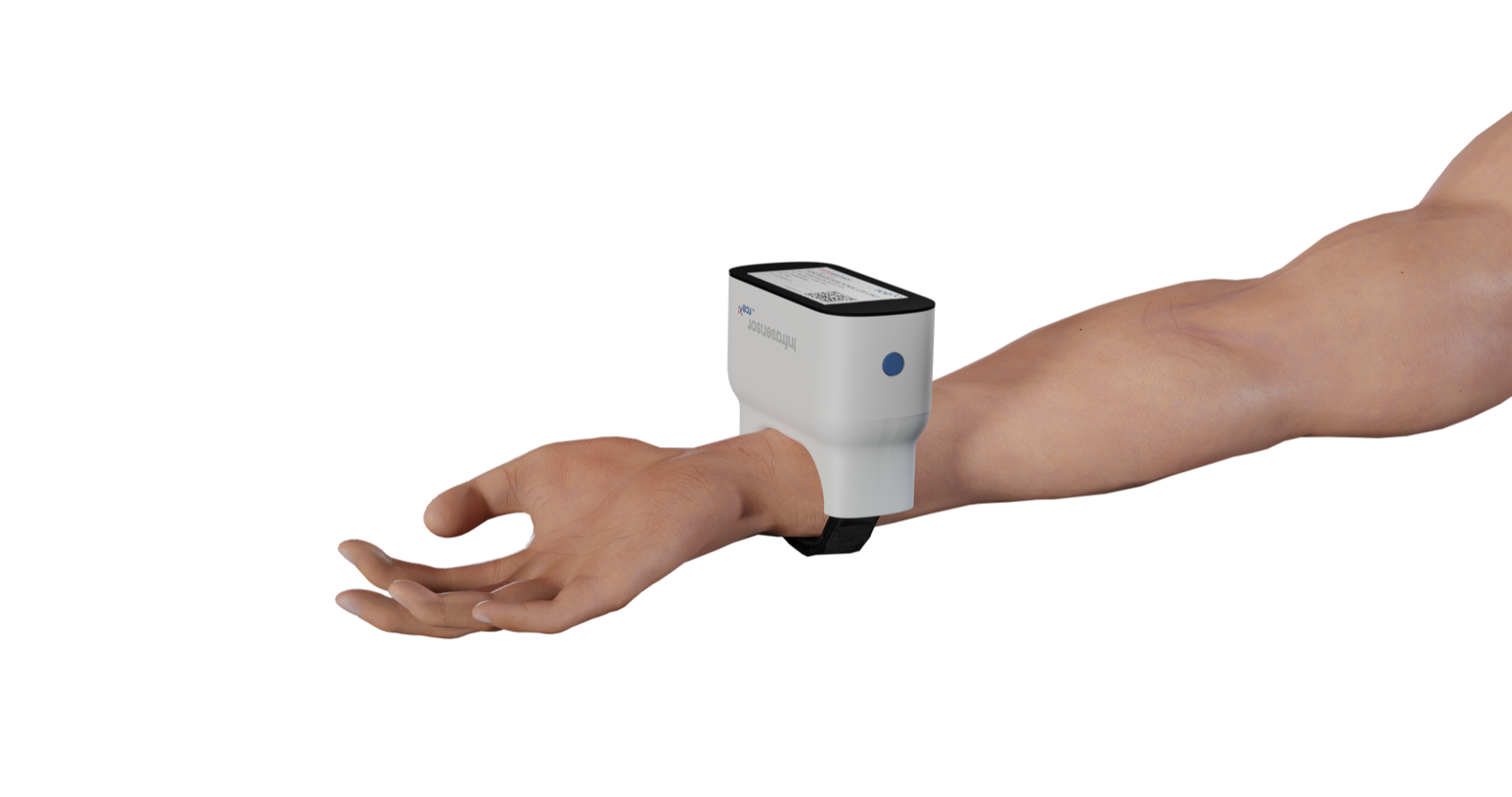
Infrasensor answers that question in approximately three minutes.
A wrist-worn, AI-enabled diagnostic platform that captures a transdermal signature and processes it through machine-learning classifiers — delivering an identification result at the initial encounter, before the hours-long serial protocol has even begun.
- NSTEMI: The Latest Evidence in Emergency Department Management, EB Medicine, 2024
- Emory Emergency Department Clinical Decision Unit data
- ACEP / Annals of Emergency Medicine, October 2024
- Kite et al., Heart (BMJ), 2024 — RAPID NSTEMI
- TIMACS
- VERDICT